
Immediate help
Had a Phone Fight Tonight?
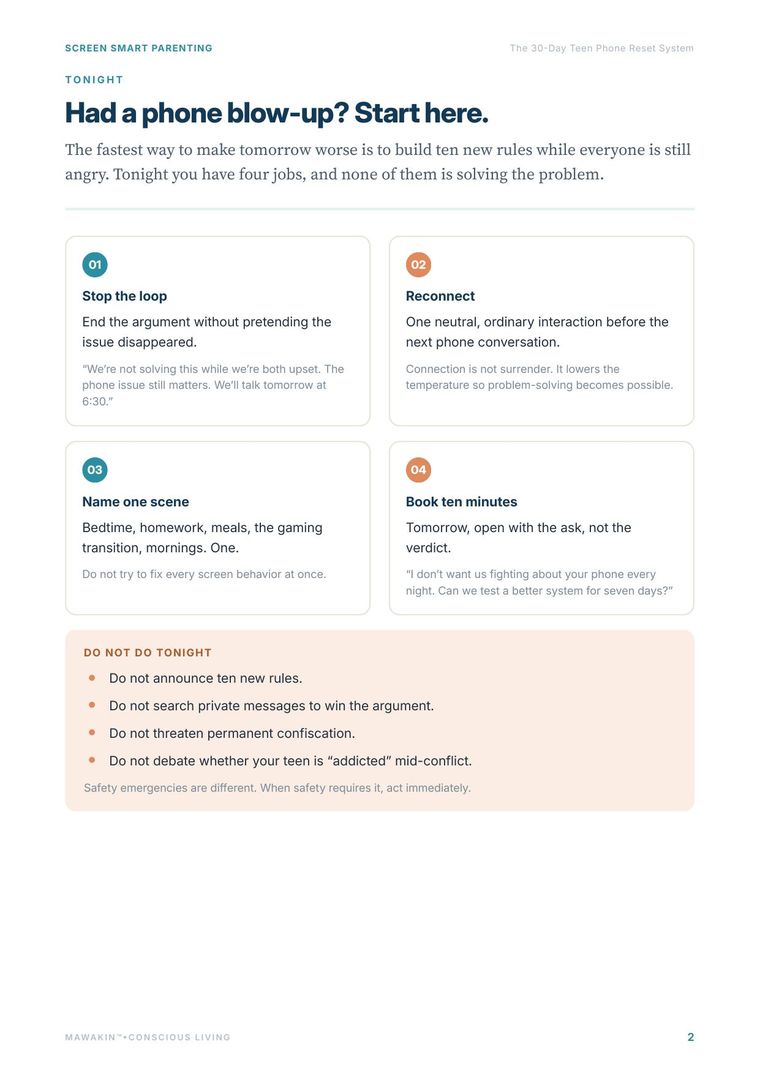
Emergency Phone Battle ResetA practical four-step process to stop the escalation, reconnect, and prepare a calmer conversation for tomorrow.
For parents of teens aged 12–16
Stop improvising rules, repeating yourself, and arguing over “five more minutes.”

30-day money-back guarantee · Instant digital access
Prefer to watch? 4-minute explanation ↓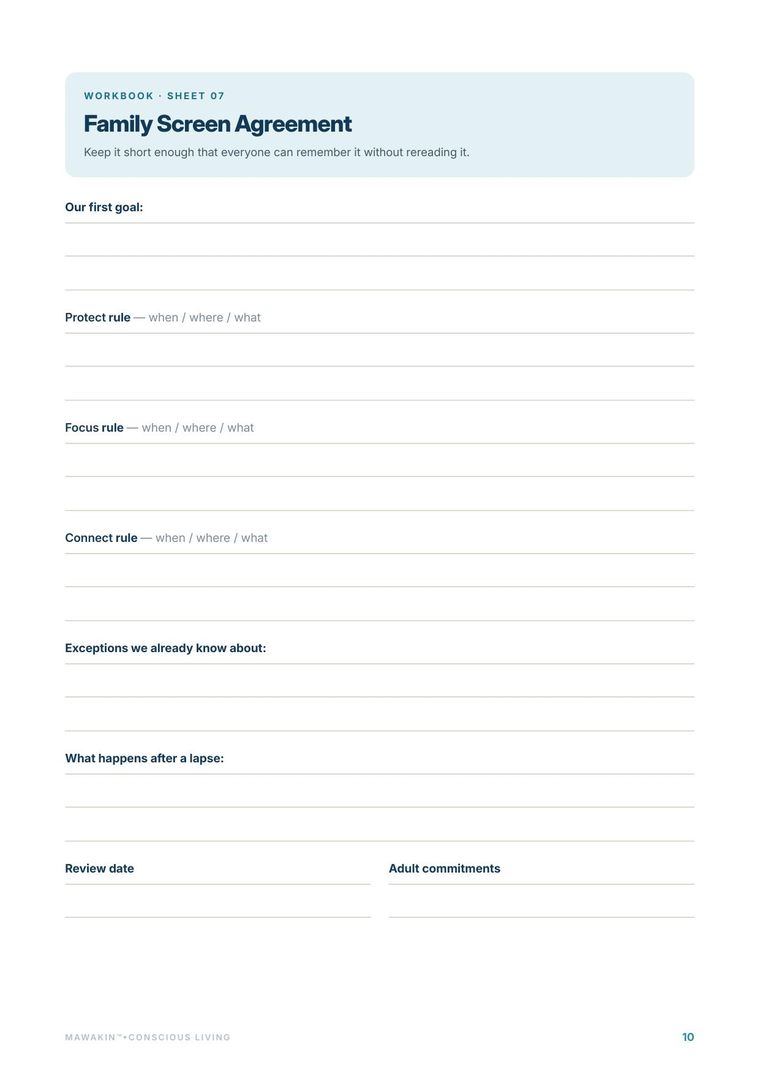
How the 30-day reset works, step by step.
Instant digital access • 30-day money-back guarantee
Less policing. More responsibility.
A look inside the system
No vague parenting tips. No endless lectures about screen time.
Here’s what you can actually open, follow, and put into practice with your family.
A practical four-step process to stop the escalation, reconnect, and prepare a calmer conversation for tomorrow.
A ready-to-fill agreement to define boundaries, exceptions, consequences, and when to review the plan together.
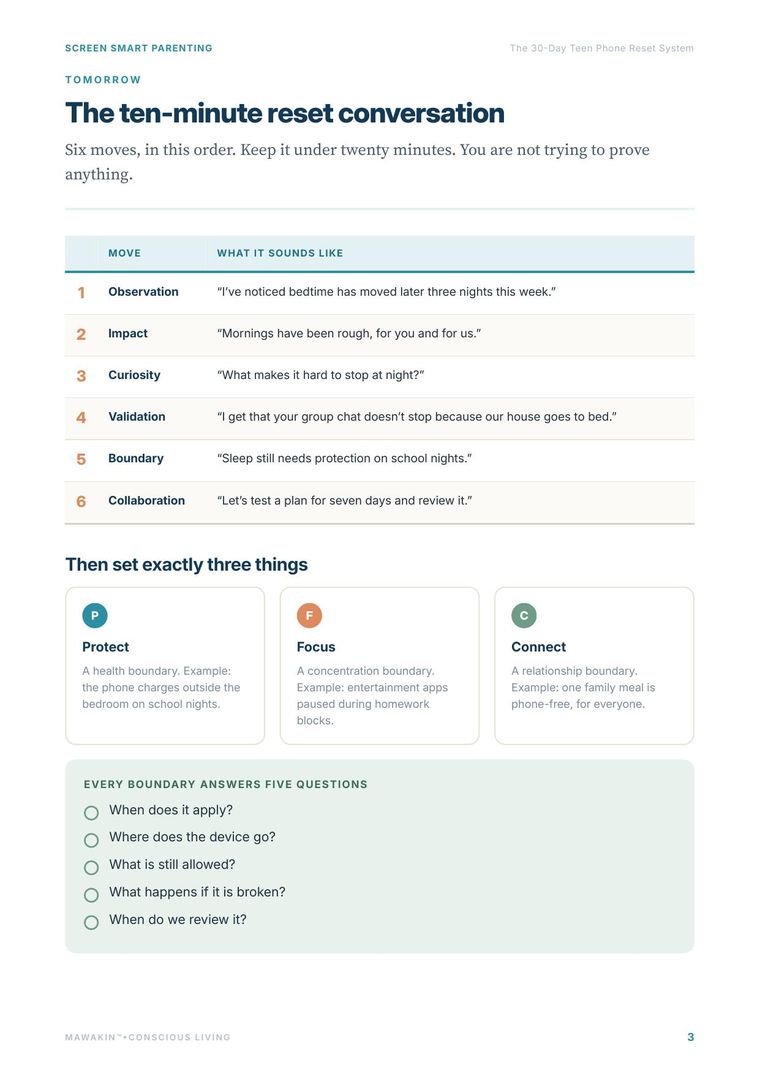
Ready-to-adapt conversation scripts for bedtime, homework, broken rules, and those “That’s not fair!” moments.
One practical action and one checkable proof point each day, so you know what to try and how to evaluate progress.
Instant Digital Access · 30-Day Money-Back Guarantee
A familiar pattern

You ask once.
Nothing happens.
You ask again.
“Five more minutes.”
Except you already gave them five more minutes.
Before long, a simple request has turned into another negotiation.
Maybe your voice gets sharper. Maybe your teenager gets defensive. Maybe you threaten to take the phone away.
Things eventually calm down. And then, another evening, a very similar situation can happen again.
It is easy to look at this pattern and think: “My teenager just won’t listen.” Or: “Maybe I need to be stricter.”
But there may be another part of the problem worth looking at.
What happens around the phone before the argument even starts?
Maybe notifications are still active during homework. Maybe the phone is within reach at bedtime. Maybe the expectation changes depending on the evening. Maybe the consequence is decided only after everyone is already frustrated.
When the expectations, routine, and environment stay largely unchanged, similar friction can keep returning.
Not because your teenager is the problem. Not because you are failing as a parent. And not because technology needs to disappear from your home.
The goal is not to win another argument over a phone. It is to stop having to improvise the same conflict again and again.
Instant digital access • 30-day money-back guarantee
The RESET Method™
Instead of asking: “How do I control the phone better?”
Screen Smart Parenting™ starts with a different question: “What can we change before the argument even begins?”
That may mean identifying one pressure point instead of trying to fix every screen habit at once. Clarifying what actually needs protecting. Creating a few predictable boundaries. Changing aspects of the environment around the phone. Having a plan for what happens when the boundary is tested. And gradually transferring more responsibility as your teenager demonstrates readiness.
This is the thinking behind the RESET Method™.
“The phone fight is often the symptom.”
“The system around it is where you can begin making changes.”
The long-term goal is not more parental control.
It is progressively less need for parental control.
Less policing. More responsibility.
Instant digital access • 30-day money-back guarantee
Where this helps
“Five more minutes” regularly turns into repeated reminders, and you want a clearer way to approach the bedtime routine.
Notifications, messages, gaming, or social media keep interrupting study time, and you want to rethink the environment without hovering over your teenager.
Taking the phone away may stop the immediate situation, but similar friction can return when the phone comes back.
You want clearer boundaries without spying, monitoring every interaction, or turning your relationship into constant enforcement.
Your goal is not to control their phone forever. You want to progressively transfer more responsibility as they become ready for it.
Instant digital access • 30-day money-back guarantee
A practical process
Screen Smart Parenting™ helps you move away from repeated improvisation and toward clearer routines, more predictable boundaries, and progressively greater teen responsibility.
Instead of trying to fix every screen habit at once, identify the moment creating the most friction.
Bedtime. Homework. Family time. Or another recurring routine.
One pressure point. One routine. One first change.Move away from rules that are invented, changed, or renegotiated in the middle of conflict.
Create a small number of expectations that are easier for everyone to understand before the difficult moment begins.
The goal is not more rules. It is more clarity.Look at the conditions surrounding the routine.
Where is the phone? When are notifications active? What happens immediately before bedtime or homework? What could make the desired routine easier to follow?
Small environmental changes can reduce how much the routine depends on repeated reminders.
Real family life does not always follow the plan.
Instead of treating one difficult evening as proof that everything failed, use a repair process to understand what happened and decide what to adjust next.
A lapse is data, not a verdict.The long-term goal is not permanent parental control.
Screen Smart Parenting™ gives you a framework for gradually transferring more responsibility as your teenager demonstrates readiness.
Less policing. More responsibility.You do not need to control every interaction with the phone.
You need a clearer process for the moments that actually matter.
Inside the system
There is already plenty of advice online about screen time. The harder part is knowing what to do in your own home.
What should you change first? Which boundary actually matters? What should you say when it is challenged? What happens after a difficult evening? When should more responsibility be handed back?
Screen Smart Parenting™ was designed to turn those questions into a practical implementation process.
Ten hard scenarios — bedtime, homework, gaming, secret use, FOMO, two homes, pushback — each with what may actually be happening, what to do, and the trap that quietly makes it worse.
What to say when your teen pushes back, written as scaffolding you adapt rather than lines to recite.
A clear place to begin when a recurring conflict needs attention now.
The system includes evidence and safety notes to help parents distinguish everyday family friction from situations that may require professional support.
The value is not in adding more parenting information.
It is in having a clearer way to turn that information into action.
Try to fix every screen habit
Start with one pressure point
Decide rules during conflict
Clarify expectations beforehand
Rely heavily on repeated reminders
Examine the environment around the routine
Treat a lapse as failure
Use the lapse as information
Keep monitoring indefinitely
Progressively transfer responsibility
Most parents do not need another article telling them that sleep, focus, family connection, and healthy technology habits matter.
They already know.
The difficult part is implementation.
Screen Smart Parenting™ was built around practical questions:
What should you change first? How do you make a boundary clear before the conflict begins? What do you do when your teenager pushes back? What happens if the routine works for three days and then falls apart? How do you know when to give more responsibility back?
The goal is not to create a home where technology disappears.
The goal is to create clearer conditions around the moments where technology keeps creating friction.
Not permanent control. Progressively less need for control.
Less policing. More responsibility.
Instant digital access • 30-day money-back guarantee
The framework
Screen Smart Parenting™ is built around the RESET Method™ — a five-part framework for approaching recurring phone conflict more deliberately.
Start by identifying where the friction is actually happening.
Bedtime? Homework? Family time? Morning routines?
Look at what the phone is providing in that moment, what it may be crowding out, and which recurring situation deserves your attention first.
You do not need to fix every screen habit at once. You need a clearer place to begin.Decide what you are trying to protect before creating another rule.
Sleep. Focus. Family connection. Responsibilities. Safety.
Clarify the outcome first so the boundary has a purpose everyone can understand.
Where more than one adult is involved, this is also the point to make expectations more consistent before introducing changes.
Create a small number of realistic expectations that can be understood before the difficult moment begins.
Not thirty complicated rules. Not consequences invented in the middle of an argument. A few clear boundaries around the routine that matters most.
The goal is not more restriction. It is more predictability.Look at the physical and digital conditions surrounding the routine.
Where does the phone charge? Are notifications active during homework? Is the phone within easy reach at bedtime? What happens immediately before the routine you are trying to protect?
Small environmental changes can reduce how much the routine depends on repeated reminders.
Observe what actually happens once the new routine is in place.
If things do not go perfectly, use the lapse as information. What happened? What made the routine difficult? What could be adjusted?
Then, as your teenager demonstrates readiness, progressively transfer more responsibility.
Because the long-term goal is not permanent parental control. It is progressively less need for parental control.
A lapse is data, not a verdict. Less policing. More responsibility.Instant digital access • 30-day money-back guarantee
Your digital toolkit

Main playbook
17 structured chapters designed to walk you through the RESET Method™ and its practical application.
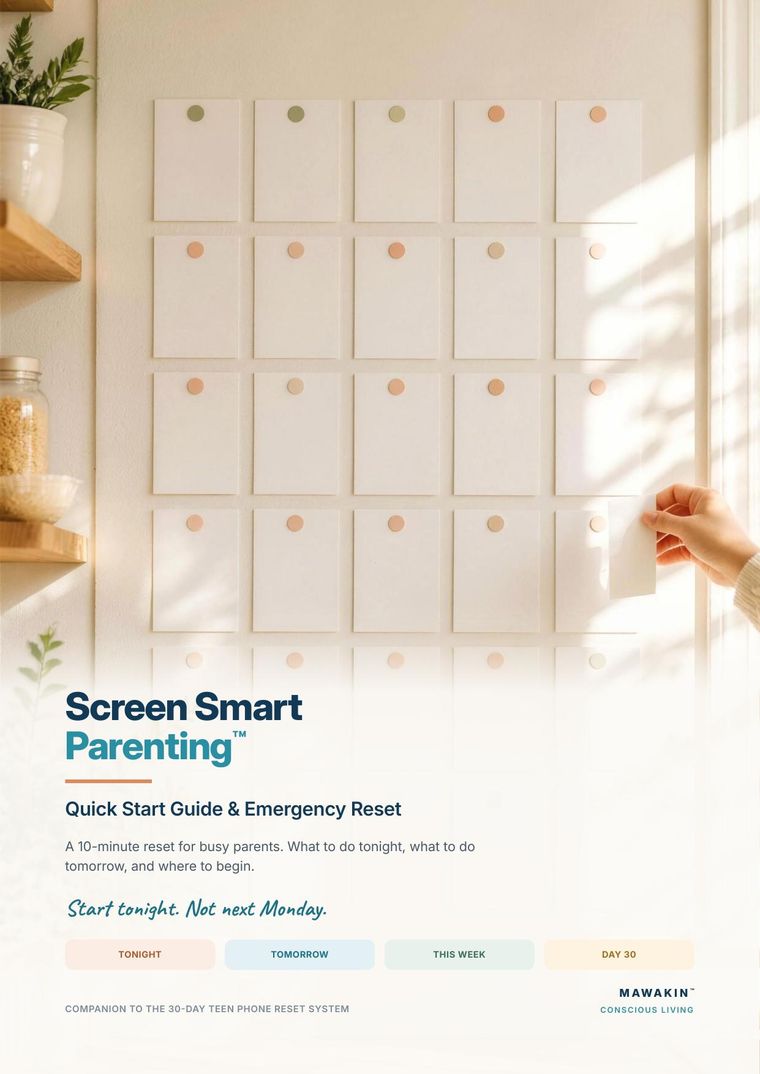
What to do tonight, what to address tomorrow, and where to begin.
The structured framework, day-by-day process, practical scenarios, scripts and RESET Method™.
Diagnostics, agreements, trackers, repair tools and autonomy-building worksheets.
Practical tools designed to help you apply the system to your own household.
Available in printable and fillable formats, in both US Letter and A4.
Screen Pressure Baseline
Parent Mirror Audit
Screen Pressure Map
First Target Selector
Parent Alignment Check
Boundary Conversation Planner
Family Screen Agreement
Friction Audit
Replacement Menu
Lapse Repair Protocol
Phone Battle Tracker
Autonomy Ladder
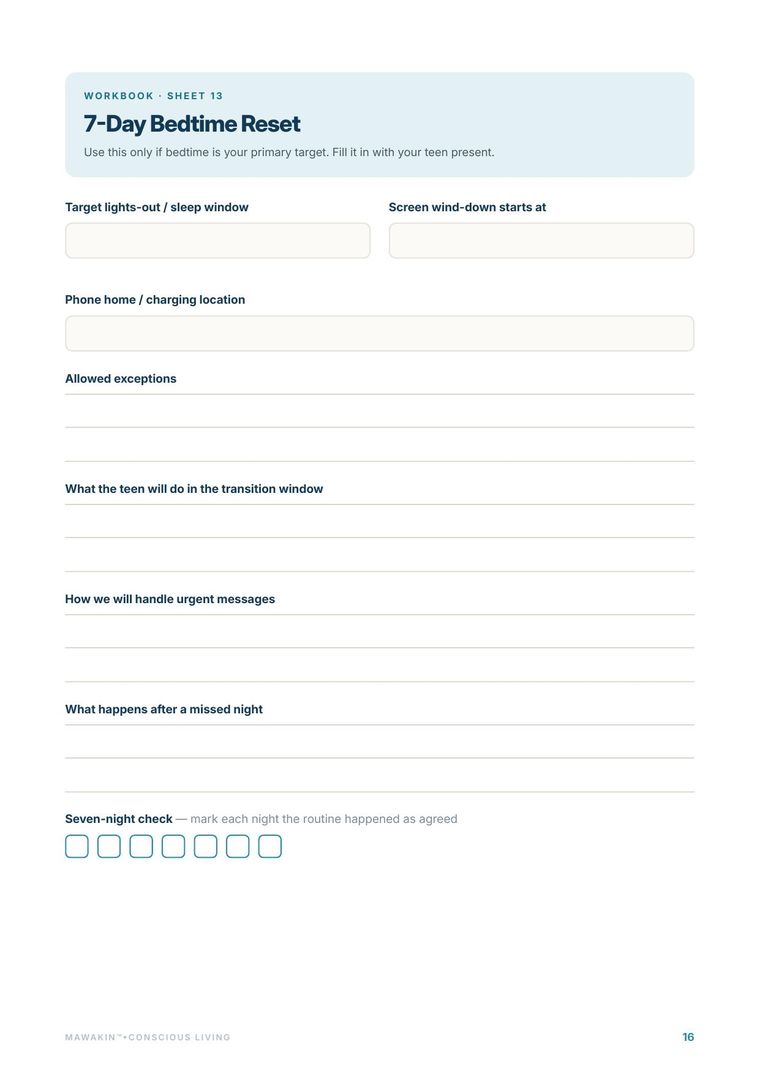
7-Day Bedtime Reset
7-Day Homework Reset
Day-30 Graduation Review
Emergency Phone Battle Reset
practical communication scripts
realistic family scenarios
evidence and safety notes
Real pages
A guided look at the playbook, worksheets, and implementation tools.
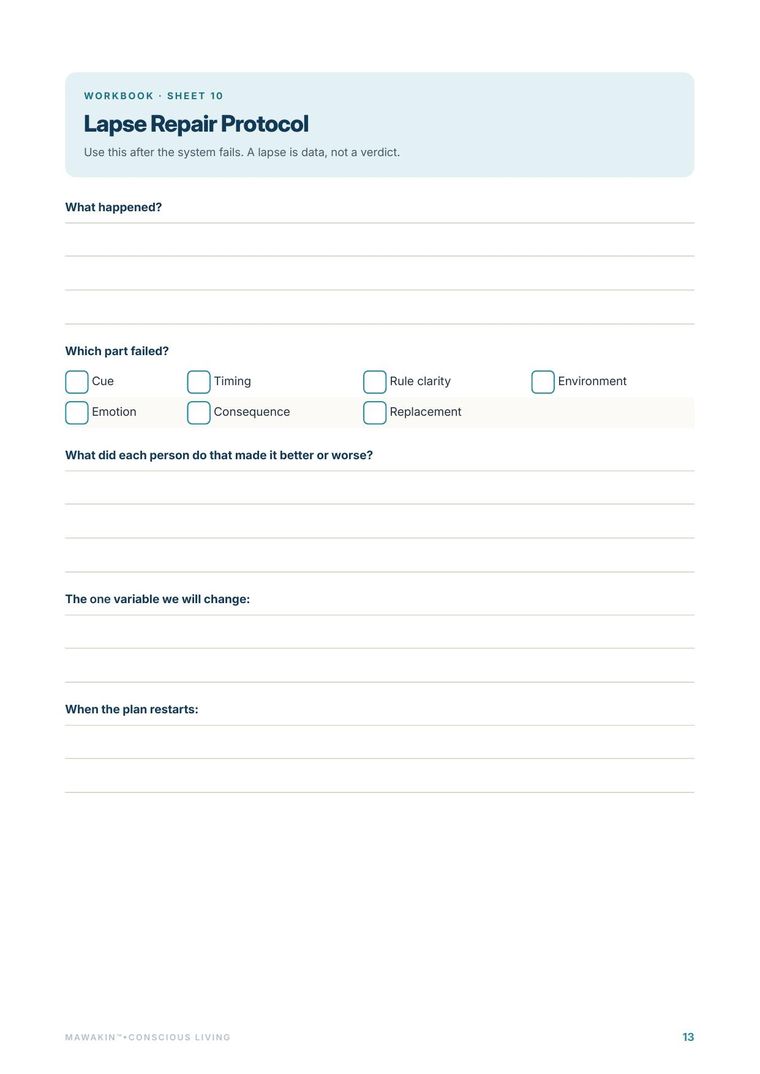
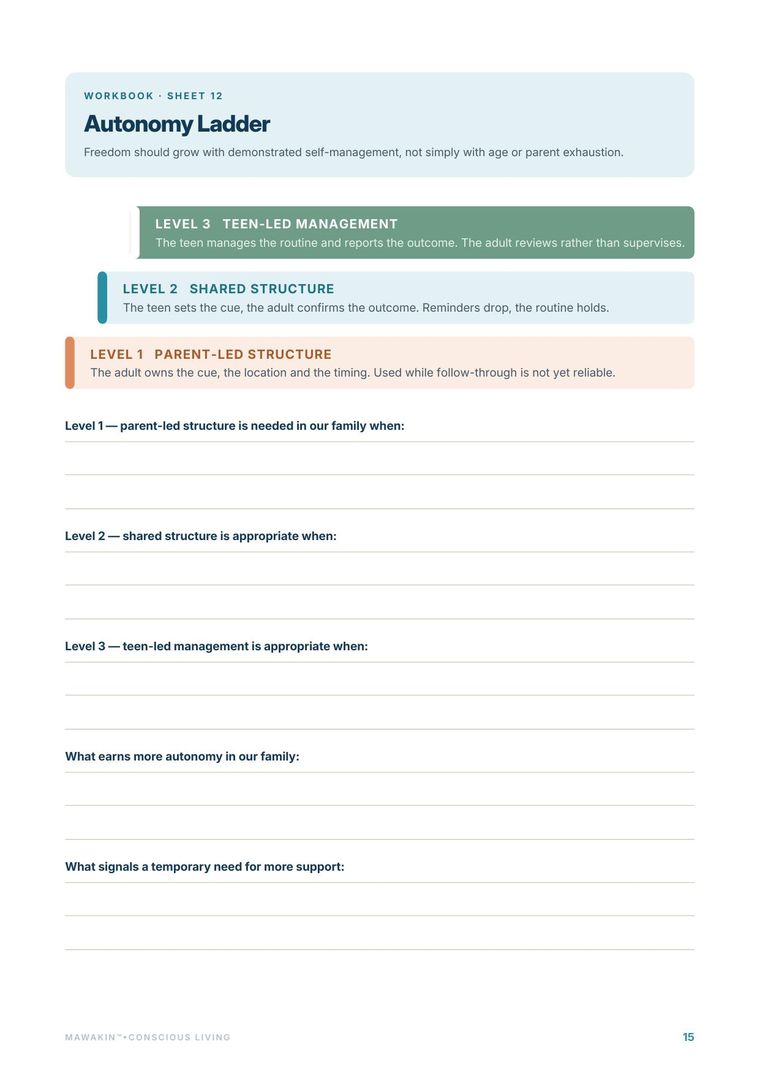
Instant digital access • 30-day money-back guarantee
Prepared, not perfect

Imagine the next bedtime routine.
The boundary has already been decided. You know what you are trying to protect. You know where the phone is supposed to go. You have already thought about what you will say if your teenager asks for five more minutes.
And if the evening does not go exactly according to plan, you know what you will look at before deciding what to change next.
You are no longer trying to invent the entire response while you are tired, frustrated, and standing in the middle of the conflict.
That does not mean your teenager will suddenly agree with every boundary. It does not mean every evening will be effortless. And it does not mean there will never be another disagreement about a phone.
It means you have a clearer process. A more predictable routine. A prepared response. And a way to adjust when real family life gets messy.
Now imagine applying that same thinking to homework. Family time. Morning routines. Or whichever pressure point creates the most friction in your home.
Instead of trying to control every minute of screen use, you begin with the moments that actually matter.
One pressure point. One routine. One first change.
Over time, the direction becomes different.
Not toward more monitoring. Not toward permanent parental control.
Toward a teenager who has more opportunities to practice responsibility — and a parent who does not have to improvise every decision in real time.
That is the future Screen Smart Parenting™ is designed to help you work toward.
Less policing. More responsibility.
One complete system
There is already plenty of information online about screen time.
You can find articles about sleep. Advice about parental controls. Lists of screen-time rules. Opinions about social media.
Screen Smart Parenting™ is not designed to give you more information to save for later.
It is designed to help you turn what matters into a practical process.
A way to decide what to change first. A framework for creating clearer boundaries. Tools for examining the environment around the phone. Scripts for moments when you do not want to improvise. A process for repairing the evenings that do not go according to plan. And a structured path toward progressively transferring more responsibility to your teenager.
Screen Smart Parenting™
Taxes may apply at checkout depending on your country.
Instant digital access • 30-day money-back guarantee
Use the system for 30 days. If it is not useful for your family, email support@mawakin.com within 30 days of purchase for a full refund.
Refund policyYou are not paying for another collection of parenting tips.
You are getting the framework, worksheets, scripts, decision tools, and implementation process to approach recurring phone conflict with more clarity and less improvisation.
One pressure point. One routine. One first change.
Clear answers
A clear place to begin
Start with the pressure point that matters most.
One routine.
One first change.
Screen Smart Parenting™
The 30-Day Teen Phone Reset System
$37
Taxes may apply at checkout depending on your country.
Instant digital access • 30-day money-back guarantee
30-day money-back guarantee. Refund policy
Less policing. More responsibility.